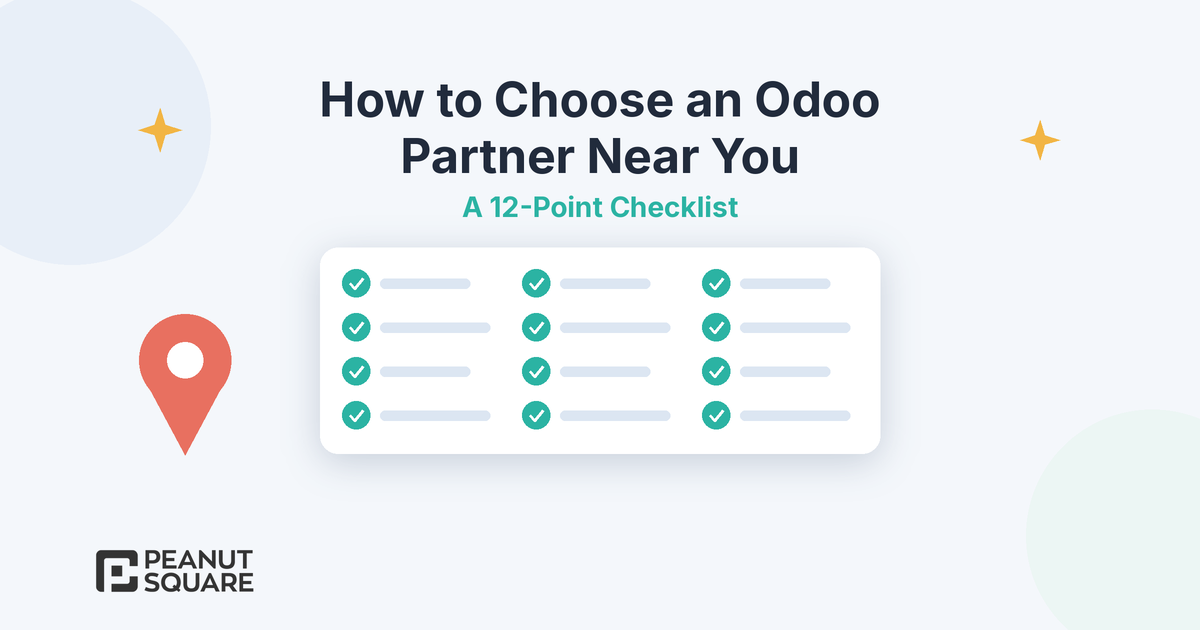
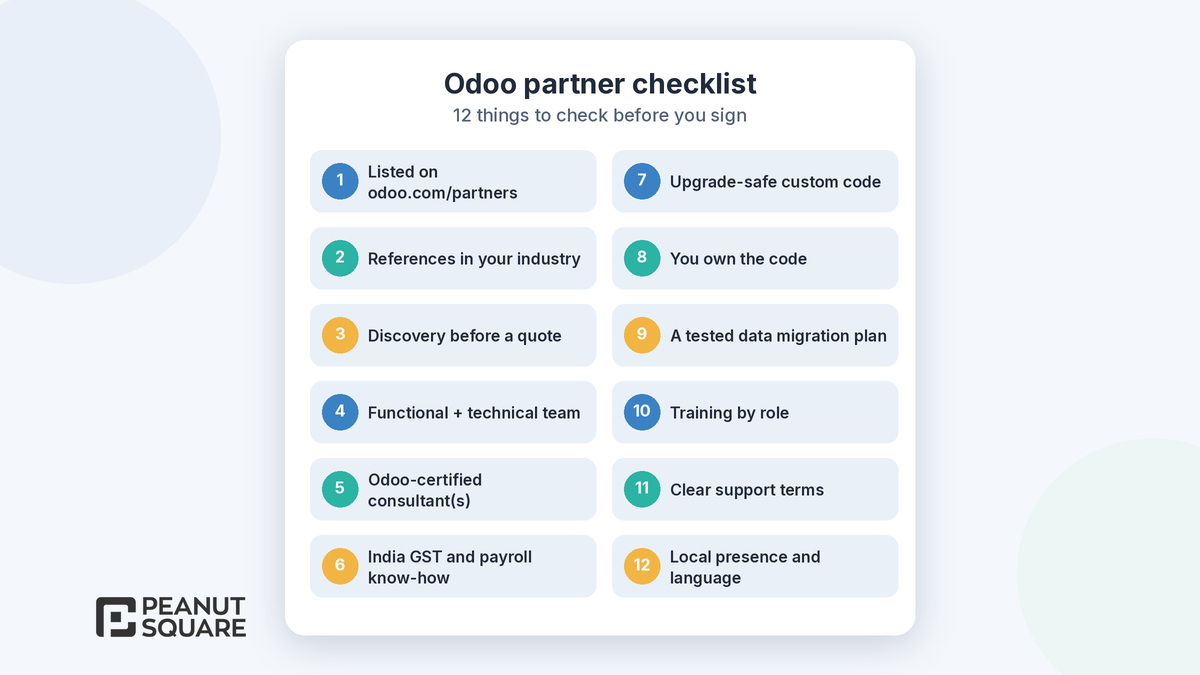
Quick answer: To choose an Odoo partner near you, first confirm the company is listed in Odoo's official partner directory. Then check references from businesses like yours, insist on a discovery phase before any quotation, and confirm the team has both functional consultants and developers. Ask who owns the custom code and how upgrades are handled, and get the support terms in writing. Local presence helps with workshops, training and support after go-live. The 12-point checklist below turns all of this into questions you can ask any partner.
Why does your Odoo partner choice matter?
Odoo is one database covering CRM, sales, purchase, inventory, manufacturing, accounting, HR and your website. Every decision your partner makes, from how a field is configured to whether something gets custom code, affects how your team works and how easily you can upgrade later. That's why a search for the "best Odoo partner near me" should end with a structured comparison rather than whoever answers first.
Credentials: points 1 to 3
1. Check the official Odoo partner listing
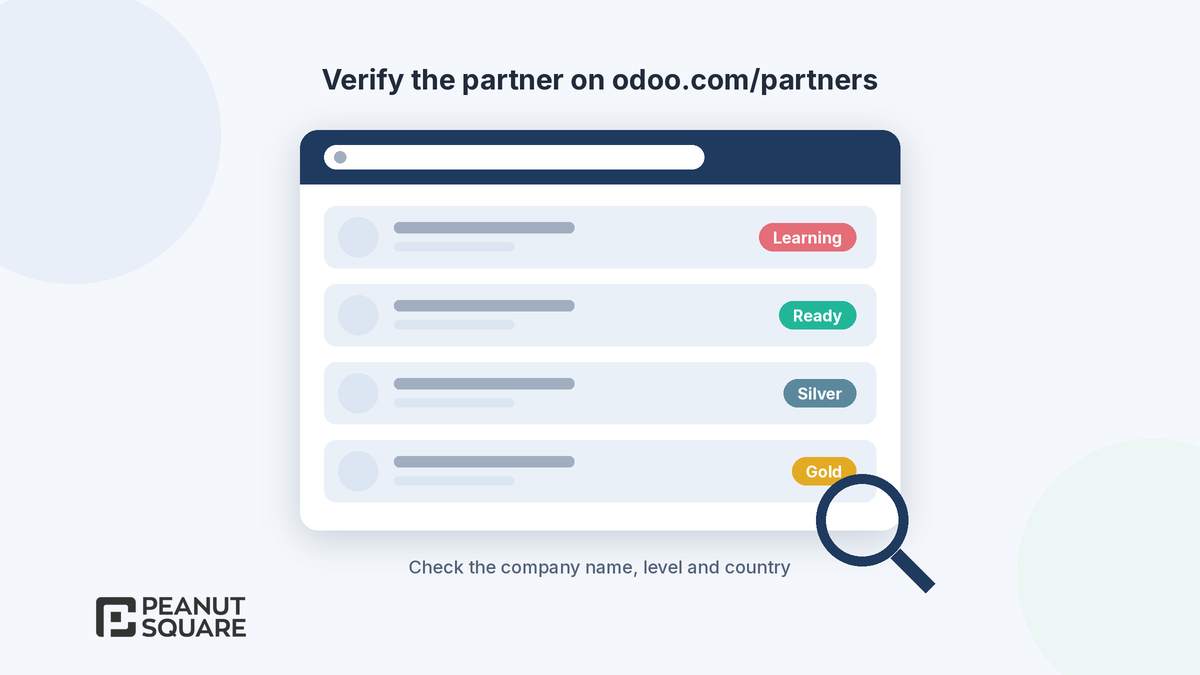
Odoo publishes its partner directory at odoo.com/partners, and you can filter it by country and industry. Look up the exact company name and note its partner level. Odoo's brand guidelines list the partner levels as Learning, Ready, Silver and Gold. The level is one useful signal. References and fit matter just as much.
2. Ask about Odoo certification
Ask which people on your project hold an Odoo certification, and whether they will actually work on your account or only appear on the sales slides.
3. Ask for relevant references
Ask for two or three clients in your industry or of a similar size, and ask whether you can speak to them. Ask those clients what went well, what slipped, and how the partner handled problems.
Process: points 4 to 7
4. Discovery before quotation
A reliable partner maps your processes before committing to scope: quote to cash, purchase to payment, stock and production. A fixed quote given before anyone has seen your processes is a red flag.
5. Functional and technical depth in one team
You need consultants who understand accounting, inventory and manufacturing flows, and developers who can build and maintain modules. When both sit in the same team, fewer requirements get lost between them.
6. India localization experience
For Indian businesses, ask the partner to show GST set up in a live or demo database. Odoo's India documentation covers e-invoicing, e-way bills and the GSTR-1, GSTR-2B and GSTR-3B reports, and Odoo 20 adds Composition Scheme and QRMP support. If you run payroll in Odoo, ask about payroll too.
7. A tested data migration plan
Ask what will be migrated (masters, open documents, opening balances), who cleans the data, and how many trial migrations will be run and reconciled before go-live.
Code and ownership: points 8 and 9
8. Custom code that survives upgrades
The right order is to configure standard Odoo first, use Studio for simple changes, and write custom modules only for real gaps. Ask how the partner structures modules, reviews code and tests it against new Odoo versions. Odoo 20, for example, changes how access rights work, so custom security needs retesting.
9. You own the code and the documentation
Your contract should say who owns custom modules, where the code is stored, and whether you get repository access and technical documentation. This makes it much easier to switch support providers later if you ever need to.
After go-live: points 10 to 12
10. Training by role
Ask for role-based training (sales, stores, production, accounts, management) and short written guides. Ask whether training can be delivered in the language your team is most comfortable with.
11. Clear support terms
Get response times, support channels, what is included, and how upgrades are handled in writing. A support plan should cover fixes, small improvements and version upgrades.
12. Local presence
A partner near you makes on-site workshops, user acceptance testing and the first weeks after go-live easier. If you're looking for the best Odoo team in Ahmedabad, put each local shortlist through this same checklist. Our guide to Odoo implementation in Ahmedabad explains what each project phase involves.
What red flags should you watch for?
A fixed price or go-live date promised before any discovery
No references you can actually contact
Vague answers on code ownership or repository access
Custom code proposed for things standard Odoo already does
No written support terms
How do you compare Odoo partners objectively?
Score each shortlisted partner from 0 to 2 on each of the 12 points: 0 means missing, 1 means partly covered, 2 means clearly shown with evidence. A total out of 24 makes the comparison objective and helps you explain the decision to your management team. Weight points 1, 4, 8 and 11 more heavily if your project involves heavy customization.
Questions to ask on the first call
Where can I see your listing in the Odoo partner directory?
Who from your team will work on my project, and who is Odoo-certified?
Which clients in my industry can I speak to?
What does your discovery phase include?
Who owns the custom code, and how do you handle upgrades?
What do your support terms cover after go-live?
How Peanut Square measures up
We encourage you to apply this checklist to us as well. Here are the facts:
Partner status: Odoo Learning Partner, founded in 2017 and based in Ahmedabad, Gujarat.
Track record: 90 Odoo modules developed and 100+ projects delivered.
Certification: our team includes an Odoo-certified consultant.
Odoo clients: Renite Vitrified (https://renitevitrified.com/), Woodleaf and Madhav Solar. See our case studies.
Services: Odoo consulting, implementation, customization and development, migration, and support.
Book a discovery call: https://www.peanutsquare.com/en/contact
About the author: Nishant Patel, CTO, Peanut Square
Nishant leads technology at Peanut Square, an Odoo Learning Partner founded in 2017 and based in Ahmedabad, Gujarat. The team has developed 90 Odoo modules, delivered 100+ projects and includes an Odoo-certified consultant.
Sources
Odoo partner directory: https://www.odoo.com/partners
Odoo brand assets (partner levels): https://www.odoo.com/page/brand-assets
Odoo India localization docs: https://www.odoo.com/documentation/19.0/applications/finance/fiscal_localizations/india.html
Odoo 20 release notes: https://www.odoo.com/odoo-20-release-notes
How do I find the best Odoo partner near me?
Shortlist local companies from the official Odoo partner directory at odoo.com/partners, then compare them on references, a discovery phase before quotation, functional and technical depth, code ownership, support terms and local presence. Score each on the same 12 points.
How can I check if a company is an official Odoo partner?
Search for the exact company name in Odoo's partner directory at odoo.com/partners, where you can filter by country and industry, and note the partner level shown.
Does the Odoo partner level matter?
It is one useful signal. Odoo's brand guidelines list partner levels as Learning, Ready, Silver and Gold. References from similar businesses, the people on your project and clear support terms matter just as much.
Should I choose a local Odoo partner?
It is not required, but a partner near you makes on-site discovery workshops, user training and fast support after go-live easier, especially for manufacturing and inventory-heavy projects.
Is Peanut Square an Odoo partner in Ahmedabad?
Yes. Peanut Square is an Odoo Learning Partner founded in 2017 and based in Ahmedabad, Gujarat. The team has developed 90 Odoo modules, delivered 100+ projects and includes an Odoo-certified consultant.