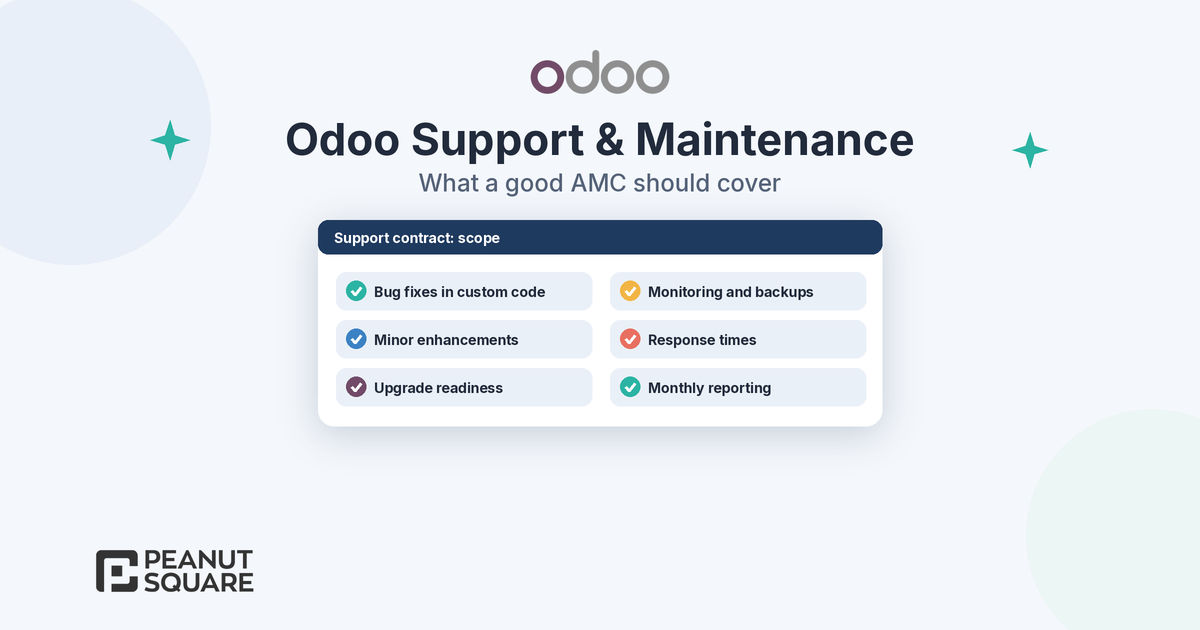
Quick answer: A good Odoo support and maintenance contract, often called an AMC (annual maintenance contract), should clearly cover bug fixes in your custom modules and configuration, a defined number of hours for minor enhancements, user support and training, monitoring and backups, preparation for version upgrades, agreed response and resolution times by priority, and a monthly report. It should complement your Odoo Enterprise subscription, which covers standard software, not replace it.
Go-live is the start of your ERP journey, not the end. New staff join, tax rules change, a custom report breaks after an update, and every year Odoo releases a new major version. This guide explains what Odoo support and maintenance should include, what the Odoo Enterprise subscription already covers, and the questions to ask before you sign an Odoo AMC. Statements about Odoo's own services come from the Odoo Enterprise Subscription Agreement and Odoo's upgrade documentation, linked at the end. Everything else is practical guidance, not a description of any specific contract.
Why does post-go-live support matter?
An Odoo database keeps changing after launch. Odoo's upgrade documentation says each major version is supported for three years, and Odoo Online databases must be upgraded at least every two years. Upgrades are not automatic for custom code either: Odoo states that a database with custom modules cannot be upgraded until those modules are available for the target version. Without a support plan, small issues pile up, custom code drifts behind the standard product, and the next upgrade becomes a project of its own.
Support also protects the investment you made in Odoo implementation. Users who get quick answers keep using the system; users who wait weeks for help go back to spreadsheets.
What does the Odoo Enterprise subscription already cover?
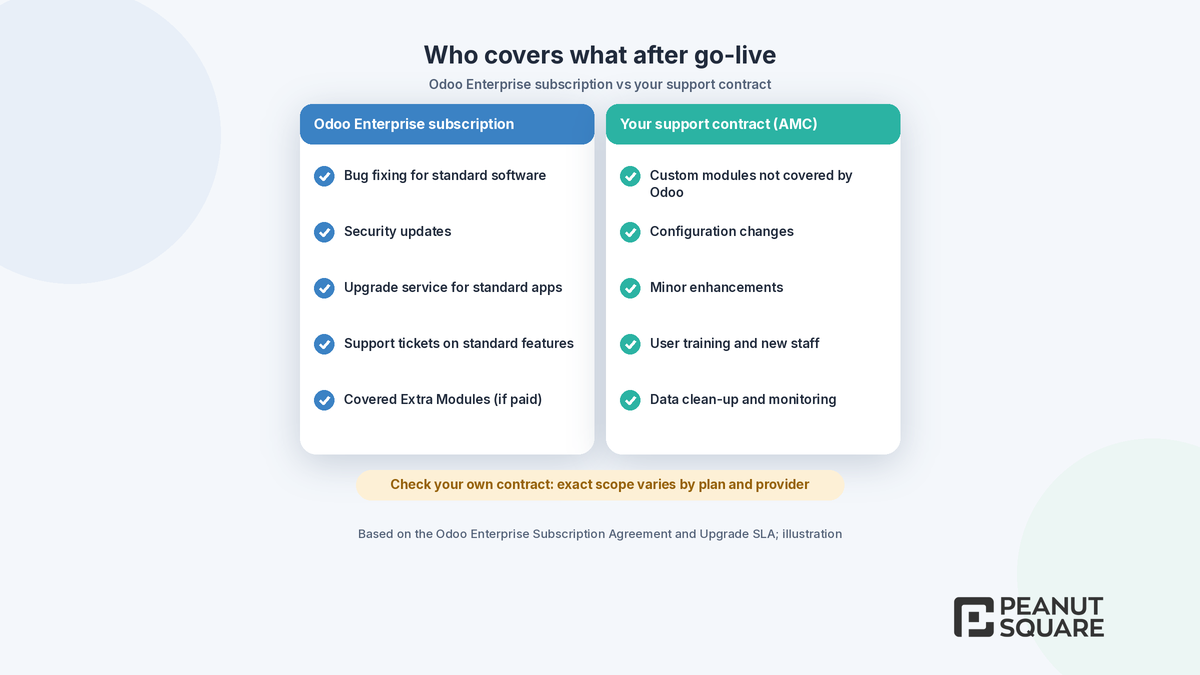
Before you scope an AMC, read what you already pay for. Under the Odoo Enterprise Subscription Agreement (20.0 version), the subscription includes:
Bug fixing: Odoo SA starts handling bug submissions within 2 business days. A bug is defined as behaviour that causes a complete stop, an error traceback or a security breach, and is not caused by a defective installation or configuration.
Covered versions: services apply to the 3 most recent major versions of Odoo.
Security updates: self-hosting customers receive security advisories at least 2 weeks before public disclosure.
Upgrade service: technical conversion of the database to a newer version. The customer remains responsible for validating the upgraded database and for adapting extra modules that are not covered.
Support tickets: unlimited, but only for bugs and guidance on standard features. Questions about development or customization need a separate service agreement.
Odoo's upgrade documentation adds that standard applications and Studio customizations (with Studio installed and an active subscription) are covered by upgrades. Not covered: cleaning up pre-existing data or configuration, modules created in-house or by third parties without a maintenance contract, and training.
That gap is exactly where an AMC fits. The agreement also allows a customer to work through a partner firm as its main point of contact, so one provider can handle both Odoo tickets and custom work for you.
Odoo support and maintenance scope: fixes, enhancements and training
The scope section is the heart of an Odoo maintenance contract. A clear scope usually lists:
Bug fixes in custom code and configuration: issues in modules your provider built or maintains, and errors caused by configuration, which Odoo's own bug fixing service does not cover.
Minor enhancements: a monthly pool of hours for small changes such as a new field, a report tweak or an automated action. Define where "minor" ends and a separate project begins.
Functional support: how-to questions from users, help with month-end closing and onboarding of new staff.
Monitoring and maintenance: for self-hosted databases, who checks backups, logs, disk space and performance. On Odoo's cloud platform, hosting is provided by Odoo SA; the agreement cites 99.9% network uptime and fully automated, verified backups.
Third-party and custom modules: which modules are in scope, by name.
Response and resolution times
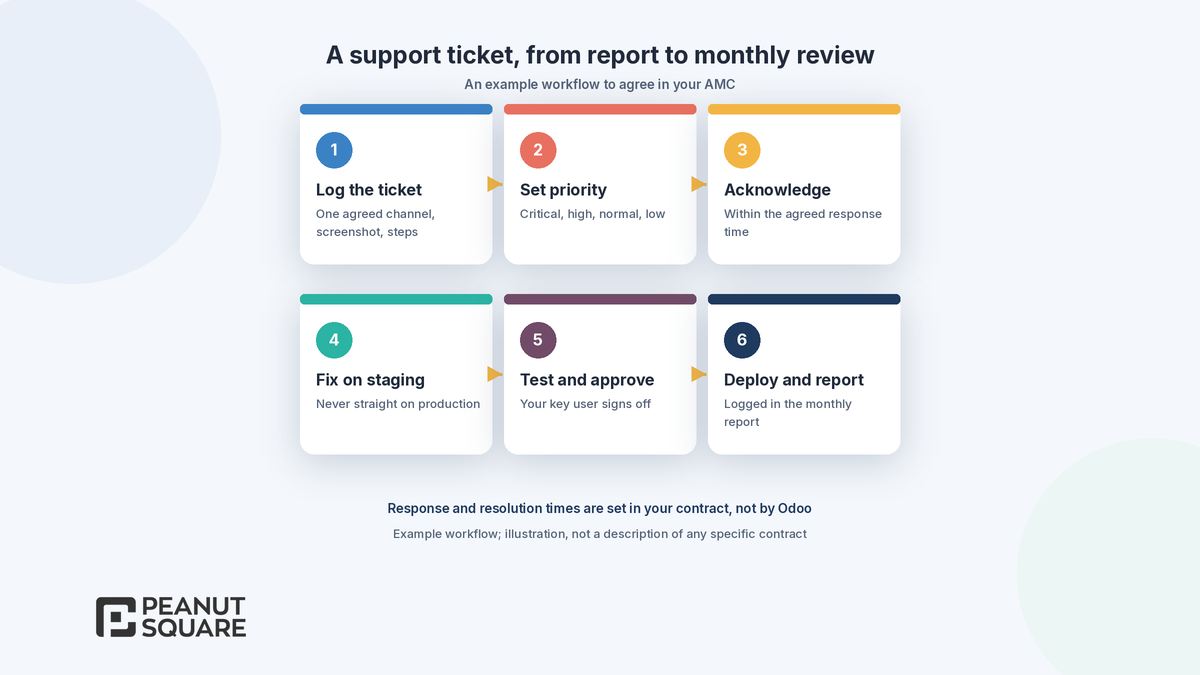
Response times in an AMC are set by your contract, not by Odoo. Agree on priority levels with plain definitions, for example critical (the business cannot invoice or ship), high (a key process is blocked with a workaround), normal and low. For each level, write down the target time to acknowledge the ticket and the target time to resolve or provide a workaround, and whether these are counted in business hours or calendar hours.
Also agree on one channel for tickets, the information a good ticket must include (steps, screenshots, user, database) and a rule that fixes are tested on a staging copy before production.
Upgrade readiness
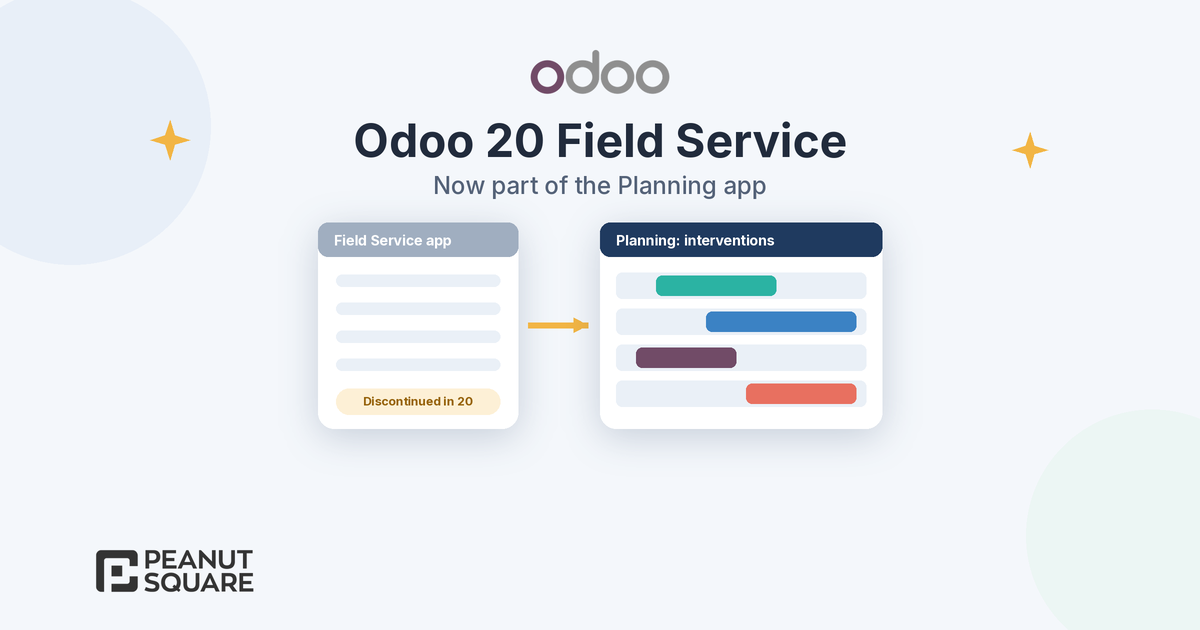
Every year brings a new major Odoo version. Odoo 20, for example, discontinued the Field Service app and moved its features into Planning, which matters if your custom code depends on it. Read our post on Odoo 20 field service for that change.
Odoo's documentation describes the upgrade process as: create a test database, upgrade your custom code, test thoroughly, report any issues and then upgrade production. Its guide to upgrading a customized database adds that you should stop new developments during the upgrade and rehearse before going live. A good AMC says who does each step for your custom modules, how much effort is included and how much is quoted separately. Our Odoo migration service and our guide to Odoo custom module development explain how to keep custom code upgrade-friendly.
Reporting
A monthly report keeps both sides honest. It should show tickets opened and closed by priority, response and resolution times against the agreed targets, hours used from the enhancement pool, open risks (for example, modules that block the next upgrade) and recommendations for the coming month. A quarterly review meeting turns the report into decisions.
Checklist: questions to ask before you sign an Odoo AMC
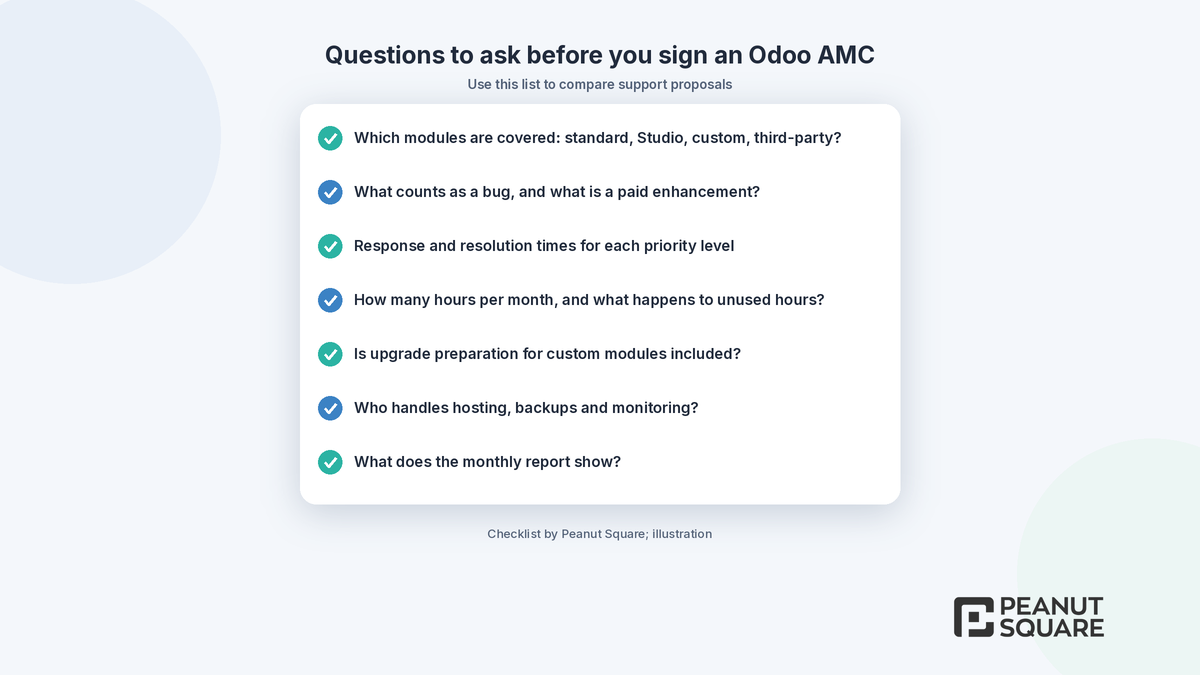
Which modules are covered: standard, Studio, custom and third-party?
What counts as a bug, and what is a paid enhancement?
What are the response and resolution times for each priority level?
How many hours per month are included, and what happens to unused hours?
Is upgrade preparation for custom modules included or quoted separately?
Who handles hosting, backups and monitoring?
What does the monthly report show, and who reviews it?
How Peanut Square supports clients
Peanut Square is an Odoo Learning Partner based in Ahmedabad, Gujarat, founded in 2017. We have developed 90 Odoo modules and delivered 100+ projects, and our team includes an Odoo-certified consultant. Our Odoo clients include Renite Vitrified, Woodleaf and Madhav Solar. Our Odoo support service covers bug fixes and error resolution, system health checks and monitoring, version upgrades and patches, and functional and technical query support. You can see examples of our work in our case studies, and if you are looking for local help, read our guides to choosing an Odoo team near you and Odoo implementation in Gujarat.
Need Odoo support and maintenance after go-live? Talk to us: https://www.peanutsquare.com/en/contact
About the author: Nishant Patel, CTO, Peanut Square
Nishant leads technology at Peanut Square, an Odoo Learning Partner founded in 2017 and based in Ahmedabad, Gujarat. The team has developed 90 Odoo modules, delivered 100+ projects and includes an Odoo-certified consultant.
Sources
Odoo Enterprise Subscription Agreement (20.0): https://www.odoo.com/documentation/20.0/legal/terms/enterprise.html
Odoo 20.0 documentation, Upgrade (including Service Level Agreement): https://www.odoo.com/documentation/20.0/administration/upgrade.html
Odoo 20.0 developer documentation, Upgrade a customized database: https://www.odoo.com/documentation/20.0/developer/howtos/upgrade_custom_db.html
Odoo 20 release notes: https://www.odoo.com/odoo-20-release-notes
What should an Odoo support and maintenance contract include?
A clear Odoo AMC should cover bug fixes in custom modules and configuration, a set number of hours for minor enhancements, functional support and training for users, monitoring and backups where you self-host, preparation for version upgrades, response and resolution times by priority, and a monthly report.
Does the Odoo Enterprise subscription include support?
Yes, for standard software. The Odoo Enterprise Subscription Agreement includes bug fixing, security updates, the upgrade service and unlimited support tickets for bugs and guidance on standard features. Questions about development or customizations need a separate service agreement.
Are custom modules covered when Odoo upgrades my database?
Not automatically. Odoo's upgrade documentation says modules created in-house or by third parties are not covered unless they are under a maintenance contract, and a database with custom modules cannot be upgraded until those modules are available for the target version.
What response time should an Odoo AMC promise?
Response times are set by your contract, not by Odoo. Agree on priority levels with plain definitions, then a target time to acknowledge and to resolve or provide a workaround for each, and whether these count business or calendar hours. For its own bug fixing service, Odoo SA commits to start handling submissions within 2 business days.
How often does an Odoo database need to be upgraded?
Odoo's documentation says each major version is supported for three years, and databases on Odoo Online major versions must be upgraded every two years. Plan upgrade preparation for your custom modules into your support contract.